Last updated on March 5th, 2026 at 05:06 pm
Introduction
Every year, thousands of Pakistan expats abroad including those living in the UK, USA, Canada, Europe, and the Middle East (Saudi Arabia, UAE, Qatar, etc.) plan to perform Hajj. Many of them face a key decision: should they travel to Pakistan and perform Hajj through the Pakistani government or a private operator, or should they book directly from their country of residence?
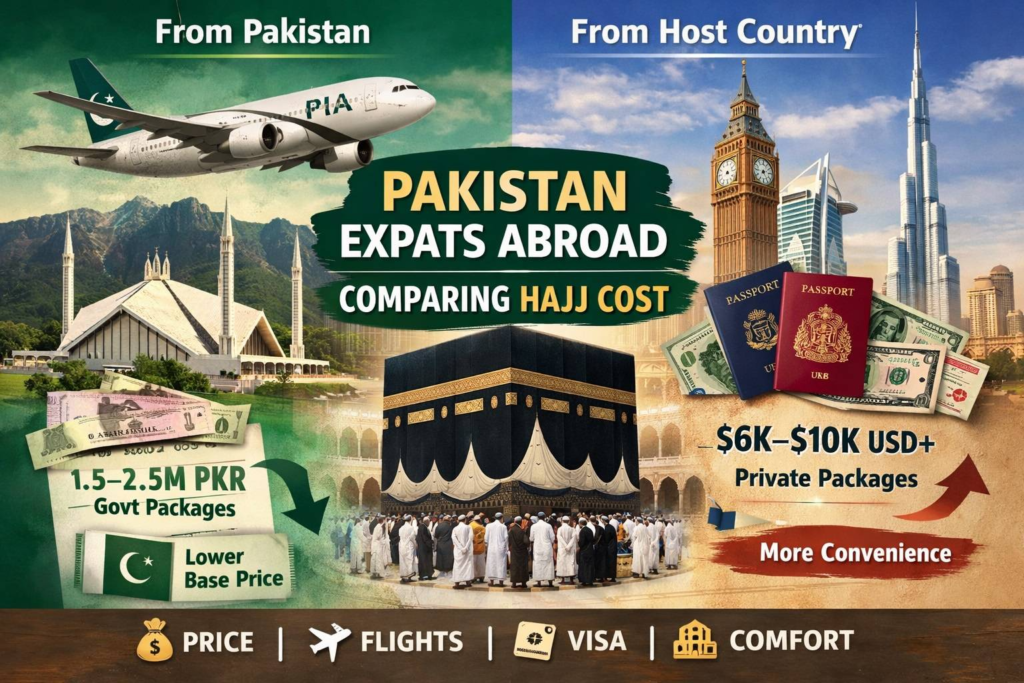
This article compares the total cost of Hajj from Pakistan versus from the host country, including government schemes and private packages. The goal is simple: identify which option makes more financial and practical sense.
This comparison matters because Hajj is not just a spiritual journey it is also a major financial commitment. Factors such as overall package cost, visa processing, travel convenience, waiting time, currency exchange rates, and accommodation quality can significantly impact the final decision. Choosing the wrong route can cost thousands of extra dollars or create unnecessary logistical complications.
Let’s break it down logically and numerically.
Key Factors That Affect Hajj Cost
If someone claims “Hajj is cheaper from Pakistan” or “It’s better from the UK,” that statement is meaningless without breaking down the components. Hajj cost is not a fixed number — it’s built from multiple variables.
Let’s dissect them properly.
1. Government vs Private Hajj Schemes
The first major cost driver is whether the pilgrim chooses a government scheme or a private operator.
Government Hajj (Pakistan):
Usually lower priced, standardized services, fixed accommodation zones, less flexibility. Payment often in PKR. However, quota limitations and balloting systems can delay participation.
Private Hajj (Pakistan or abroad):
Higher cost, but more control over hotel category, transport, room sharing, and group size. For expats, private operators often provide smoother handling and customized arrangements.
In countries like the UK or USA, government-subsidized options do not exist — nearly all packages are private and therefore priced higher.
Bottom line: government schemes reduce cost but reduce flexibility.
2. Duration of Package (Short vs Long Stay)
Package duration directly impacts cost.
Short Hajj (14–18 days):
Lower hotel cost, lower transport and food cost. Usually more intense schedule.
Standard / Long Hajj (30–40 days):
More comfortable timeline but significantly higher accommodation and service costs.
Luxury and VIP packages extend duration with premium hotel access and private tents in Mina, which drastically increases price.
More days = more hotel nights = higher cost. Simple math.
3. Airline, Flight Class & Route
Flights can create a huge price gap.
- Direct flights are more expensive but reduce fatigue.
- Transit flights lower the ticket price but increase travel time.
- Economy vs Business class can double or triple airfare.
Flights departing from the UK, USA, or EU are naturally more expensive than flights from Pakistan due to distance and currency strength. However, an expat choosing Hajj package from Pakistan with a registered Hajj group must also factor in the cost of traveling to Pakistan first.
Ignoring airfare math is where many people miscalculate.
4. Hotel Category & Proximity to Haram / Mina
This is one of the biggest price differences.
- Hotels within walking distance of Masjid al-Haram cost significantly more.
- Hotels in Aziziyah or farther zones are cheaper but require shuttle transport.
- In Mina, standard tents vs upgraded air-conditioned VIP tents drastically change pricing.
The closer the hotel to Haram, the higher the package price. There is no shortcut here.
Comfort has a premium.
5. Visa & Documentation Costs
Visa processing varies depending on the country of application.
- From Pakistan: handled through the Ministry of Religious Affairs (for govt scheme) or licensed private operators.
- From UK/USA/EU: applications go through authorized Nusuk-linked operators, often bundled within the package cost.
Foreign-based applications usually include service charges, insurance, and administrative fees in USD or GBP, which increases total cost.
Additionally, expats performing Hajj from Pakistan must consider:
- Travel to Pakistan
- Local stay expenses
- Currency conversion losses
If these aren’t calculated, the “cheaper from Pakistan” assumption can be misleading.
Cost comparison only makes sense when all these components are added together. In the next section, we’ll break down the actual numbers.
How Pakistan-Based Hajj Packages Work
If an expat decides to perform Hajj through Pakistan instead of their country of residence, they must understand how the Pakistani system actually operates — not what people assume.
1. Pakistan Government Hajj Scheme
The Pakistan Government Hajj Scheme, managed by the Ministry of Religious Affairs, operates on a quota system allocated by Saudi authorities.
Key characteristics:
- Balloting system (if applications exceed quota)
- Installment payments (initial deposit + second installment)
- Two main options:
- Short Hajj Package (approximately 20–25 days)
- Long Hajj Package (approximately 35–40 days)
The government package is standardized. Pilgrims cannot customize hotels, tents, or flights beyond the assigned structure.
This keeps pricing controlled — but flexibility is minimal.
2. Typical Cost Ranges (Economy vs Business-Style Private Packages)
Costs vary each year based on Saudi service charges, exchange rates, and airfare.
Generally:
- Government Economy Package:
Among the lowest-cost options available globally. - Private Economy Package (Pakistan-based):
Higher than government but still competitive compared to UK/USA pricing. - Private Executive / Business-Class Style Packages:
Premium hotels near Haram, better Mina tents, sometimes upgraded flights — significantly more expensive.
The price gap between government and high-end private can be massive. You’re essentially paying for comfort, proximity, and service ratio.
3. What’s Typically Included
Most Pakistan-based packages (government and private) include:
- Return airfare (economy unless upgraded)
- Hotel accommodation in Makkah and Madinah
- Mina tent accommodation
- Internal Saudi transport (airport–hotel–Mina–Arafat–Muzdalifah)
- Zamzam allowance (as per Saudi policy)
- Basic meals (varies by operator)
- Group guidance and religious scholars
However, service quality differs drastically between operators. The inclusion list may look identical on paper, but execution is not the same.
4. Pros & Cons for Expats Applying from Pakistan
This is where logic is required.
Pros
- Lower base package price compared to UK, USA, or EU operators
- Payment in PKR (useful if the expat maintains assets in Pakistan)
- Access to government-subsidized structure
Cons
- Travel cost to Pakistan (return ticket from UK/USA/Middle East)
- Time off work for extended stay in Pakistan before departure
- Currency exchange risk (if converting GBP/USD into PKR)
- Application timing must align with Pakistan’s Hajj schedule
- Potential quota limitations
Many expats only compare package price — and ignore airfare to Pakistan, local living expenses during waiting period, and opportunity cost of time.
When these are added, the “cheaper from Pakistan” argument becomes more complex than it initially appears.
In the next section, we’ll compare how host-country packages are structured.
4. Hajj from the Host Country (USA, UK, UAE, KSA, etc.)
Most Pakistani expats abroad perform Hajj through licensed operators in their country of residence rather than applying through Pakistan.
How Applications Usually Work
In countries like the UK and USA, Hajj bookings are typically handled by:
- Licensed Hajj travel agencies
- Approved Nusuk-registered operators
- Saudi-authorized organizers
- Embassy-linked quota systems (depending on country)
There is no “government-subsidized” low-cost scheme like Pakistan. Nearly all packages are private and priced commercially.
In Gulf countries such as UAE, Qatar, or Saudi Arabia (for resident expats), applications are usually processed through:
- Local Islamic affairs authorities
- Licensed Hajj operators
- National quota systems based on residency status
The process is generally more digitalized and centralized compared to Pakistan.
Typical Price Ranges (Approximate)
These are broad market ranges. Exact figures vary yearly based on Saudi fees, airfare, and currency exchange.
USA
- East Coast Packages:
Typically slightly cheaper due to shorter distance to Saudi Arabia. - West Coast Packages:
Higher airfare component.
Estimated Range: $6,000 – $12,000+ per person, depending on hotel proximity and tent category.
UK (London, Birmingham, Manchester)
UK packages are among the most structured and regulated.
Estimated Range: £6,000 – £11,000+ per person, depending on hotel star rating and Mina setup.
Proximity to Haram and private Mina tents push costs significantly higher.
Gulf Countries
For residents in UAE, Qatar, or Kuwait:
Estimated Range: AED 35,000 – AED 60,000+ per person
Shorter flight distance helps, but premium accommodation and service standards keep prices elevated.
Inclusions & Service Differences
Host-country packages often include:
- Direct international flights
- 4–5 star hotels near Haram
- Shorter walking distances
- Organized group leaders fluent in English
- Structured meals (sometimes buffet style)
- Higher service ratio (guide-to-pilgrim)
However, higher comfort comes with a price.
There is less “basic economy” style offering compared to Pakistan’s government scheme.
5. Side-By-Side Cost Comparison (Approximate)
Note: Figures vary every year.
| Factor | From Pakistan (Govt) | From Pakistan (Private) | From Host Country (UK/USA) |
| Base price range (approx) | 1.5–2.5M PKR | 2.5–4M PKR | $6,000–$10,000+ |
| Flight arrangement | Pakistan–Jeddah/Med | Pakistan–Jeddah/Med | Direct from host country |
| Visa & documentation | State-managed | Agency-managed | Local embassy/agency |
| Hotel quality & distance | Basic to mid-range | Mid to high-range | Often high-end, close to Haram |
| Extra hidden costs | Fewer | Some | Often higher insurance & service charges |
Headline price is not the final price. Total cost depends on logistics.
6. Case Examples: Realistic Scenarios
Example 1: Family in London
Option A: Apply from Pakistan (Govt Scheme)
- Govt package (PKR equivalent)
- 4 return tickets London–Pakistan
- Local stay in Pakistan before departure
- Currency conversion from GBP to PKR
After adding airfare and extra time costs, savings shrink.
Option B: UK-Based Operator
- Higher base package in GBP
- Direct departure from London
- No extra travel or visa back to Pakistan
For a family of four, the difference may narrow once all logistics are included. The cheaper headline number may not remain cheaper overall.
Example 2: Couple in Dubai
Option A: Apply through Pakistan
- Travel Dubai–Pakistan–Saudi
- Accommodation in Pakistan pre-departure
- PKR currency conversion
Option B: UAE-Based Package
- Direct departure
- Structured local processing
- Higher AED package price
For Gulf residents, applying locally often makes more sense logistically, even if base price is higher.
7. When It’s Cheaper to Apply from Pakistan
Pakistan-based Hajj can be more affordable when:
- The government scheme is secured through balloting.
- The pilgrim already plans extended time in Pakistan.
- PKR depreciation benefits foreign currency holders.
- Installment structure reduces immediate cash burden.
Trade-offs:
- Limited hotel choice.
- Longer processing timeline.
- Less customization.
- Need to physically be in Pakistan for stages of the process.
8. When It’s Better to Apply from the Host Country
Host-country packages make more sense when:
- Convenience matters more than headline price.
- You cannot afford long stays in Pakistan.
- You want hotels within short walking distance to Haram.
- You prefer English-speaking guides and organized structure.
- You need faster decision timelines.
Time and comfort have value. Not everything is about the lowest number.
9. Hidden Costs to Watch For
Many people underestimate these:
- SIM cards
- Meals outside package
- Tips for service staff
- Extra transport within Makkah
- Souvenirs & gifts
- Additional insurance
- Medical tests or vaccinations
- Currency exchange losses
If paying from abroad into PKR accounts, exchange volatility can change total cost significantly.
Always calculate an additional 10–15% buffer.
10. Practical Tips for Pakistan Expats
Before deciding, ask:
- What exactly is included in the package?
- How far is the hotel from Masjid al-Haram?
- What type of Mina tent is provided?
- Who handles visa and documentation?
- Are meals fully included?
Estimate:
Total Hajj Cost = Base Package + Travel Logistics + Hidden Costs + Emergency Buffer
Start planning 1–2 years in advance, especially if targeting government schemes with quota limitations.
Waiting until the last-minute increases cost drastically.
11. Conclusion
For Pakistan expats abroad, Hajj from Pakistan often presents a lower headline price — particularly through the government scheme.
However, host-country packages offer convenience, structured processing, better accommodation, and reduced logistical stress.
The cheapest option on paper is not automatically the best option in reality.
The smart approach is simple:
Compare at least three routes:
- Pakistan Government Scheme
- Pakistan Private Operator
- Host-Country Licensed Operator
Then calculate total out-of-pocket cost — not just brochure price — before making a decision.